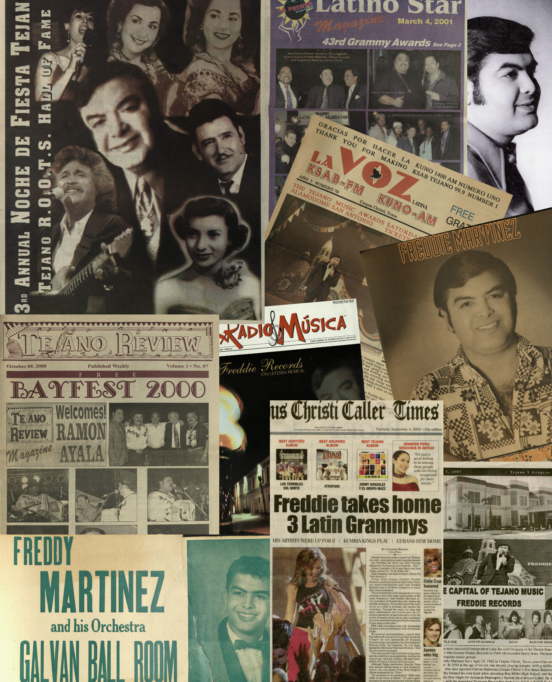
Walking the storied halls of Freddie Records feels, in many ways, like stepping into a museum of Tejano music and the heart of a culture that thrives today because of those who came before. Its walls pay homage to the artists—greats like Ramón Ayala, Lucky Joe and Jimmy Gonzalez, as well as groups like Siggno, La Fiebre and Selena y Los Dinos in their early years—who have called the label home at one point or another over the 56 years since it started operations in Freddie and Joann Martinez’s garage.
While the label itself may have begun operating in 1969, the dream that the Martinez family spearheads today began long before with their father, grandfather and founder of the label, Tejano legend Freddie Martinez Sr.
Before Tejano found its footing as the premier sound of Hispanic culture in Texas, La Onda Chicana gave rise to many Mexican American artists across the country. Taking root in the core of the civil rights movement of the 1950s and ’60s, La Onda Chicana gave rise to a bicultural perspective on music. It was formed by blending traditional beats and sounds from the merged worlds of Chicano artists: ranchera, tejano, cumbia arrangements married to the emerging sounds of American R&B and soul, rock and doo-wop. Freddie Martinez emerged on the scene during this time as a fresh-faced 15-year-old, though no stranger to the music business, whose career would grow alongside the genre itself.

“When my dad was growing up, his uncles—Ralph, Eddie, Sammy, Bobby Galvan—were prominent musicians and orchestra leaders in the ’40s and ’50s,” Freddie Martinez Jr., Co-President of Freddie Records, said of his father’s early exposure to the business the whole family would later dedicate themselves to.
Martinez Sr. took influence from his uncles and his grandfather, Rafael Galvan, who opened the Galvan Ballroom in 1950 to promote his orchestra and bring big-name artists to perform in the Coastal Bend. Some of Martinez’s earliest performances were in the famed ballroom with his grandfather’s orchestra, before initially setting off on his own as the Freddie Martinez Orchestra.
Throughout his late teens and 20s, Martinez worked as a KCCT radio DJ part-time in addition to being a working musician—gigging his way across Texas and the U.S.— as a means of networking within the business. By 1969, Martinez found himself at a crossroads: 15 years into the business, out of new labels to record with in hopes of striking new heights, a husband and father to a young, growing family he needed to provide for. His wife, Joann, had run a hair salon out of the efficiency apartment behind their house on Brentwood Drive when the two decided that the space would double as a recording space.
With an initial $400 investment and the freedom to record what he wanted, Freddie Records was born.
Martinez Jr. recalls one of his earliest and most vivid memories from the small garage where his parents would work. “My mom was a beautician and had set up her beauty shop [in the garage], and at night my dad would use that rehearsal room with his band,” he said. He recalled his dad picking him up and seating him atop one of the hydraulic salon chairs, watching in awe as the seven-piece band performed in the small garage—guitar, bass, drums, trumpets, saxophones, his dad at the helm on vocals and trumpet. “I was a little kid, and I didn’t know what they were saying. But it was loud, and it was powerful. I knew something special was going on, and it was uncharted territory.”
Martinez Sr. would find new heights to his success under his own label. His first single, “Necesito Tu Amor,” quickly garnered enough play to release more singles, and eventually led to his first album, Botoncito de Cariño, which made a considerable impact. It was in 1971 that Martinez Sr. struck gold with his fourth album, Te Traigo Estas Flores, and catapulted him into Tejano stardom.

“He was touring all over the United States and Mexico, appearing on national television shows and playing prestigious venues,” Martinez Jr. said of his father’s breakthrough. “He played Madison Square Garden, the Hollywood Palladium—not many Latin or Tejano artists were playing those venues back then. It was a very magical time.”
As Martinez’s star rose, so did the label’s reputation.
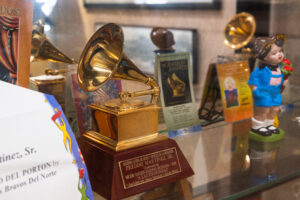
Freddie Records built more steadily over the next decade, finding its stride in 1973 by signing Ramón Ayala, who would find incredible success as a solo artist at Freddie Records after parting ways with his duo, Cornelio Reyna and Los Relámpagos del Norte. Martinez Sr. and the label have garnered six Grammys and Latin Grammys along the way, and have boasted a roster that at times included Ayala, his band Los Terribles del Norte, Jimmy Gonzalez y Grupo Mazz, Sunny and the Sunliners, Elida Reyna and dozens of other iconic acts.
Tejano evolved into its signature sound that we know today, and a new generation in the Martinez clan grew alongside it. Today, every generation has a part to play in the family business that serves a growing roster of artists and millions of listeners.
Freddie Martinez Jr. oversees Freddie Records as co-president, alongside his brothers John, who heads up digital media partnerships and daily operations, and Marc, who leads radio promotion and partnerships nationwide and in Mexico. For all their success, being an independent, family-owned business has motivated them to run the label in a way that reflects their values.
“The music business can be the kind of business that chews people up and spits them out,” Melody Martinez—elder daughter of Freddie Jr. and digital media specialist for the label—said. “For our family, and my grandpa especially, it has always been really important to let artists have creative freedom.”
“It’s important to maintain the core values of what my grandpa has envisioned for the company,” Monique Martinez—the younger daughter of Freddie Jr., executive assistant and signed artist to the label—said of continuing the legacy of Freddie Records. “I’m excited for it to grow and to see how many other different artists we can bring in, something different and unique that maybe the label has never seen before.”
Martinez Sr. balances his role as CEO by delegating day-to-day operations to his sons so he can enjoy time with Joann while the label continues to adapt to the current music landscape. Martinez Jr. spoke on the sense that a second life for Freddie unfolds as the next generations start to come forward to take part in the family business—not quite passing the torch, but keeping the flame.
“My dad has been the greatest teacher that I could have asked for, both him and my mother,” Martinez Jr. said, reflecting on his own role as a father and mentor to his daughters as they have come into their roles in the company. “There’s nothing like having family be part of the business. They share in the responsibilities and in the heritage that is part of the company. They want to see it continue, and I know it means just as much to them as it does to me.”
At the Freddie Records headquarters, Tejano history mingles with the personal history of the Martinez family.
Melody and Monique step into the role of consummate professionals and burgeoning faces of the label as they showcase exhibits of history in the halls of the label’s office with the ease of people who grew up here, pausing beside an accordion once played by Ramón Ayala, or the pants their grandfather wore in an old western, La Muerte de Pancho Villa, starring Mexican film superstar Antonio Aguilar. Farther back into the warehouse, among boxes of the label’s merchandise and physical media, the sisters exchange sidelong glances and smiles over family photos and artifacts of the evolution of Freddie, like the iconic neon trumpet logo that used to serve as a historic marker for many Corpus Christians. The artifacts tell the story of where Freddie Records has been, but the family moving among them points to where it’s going next.