

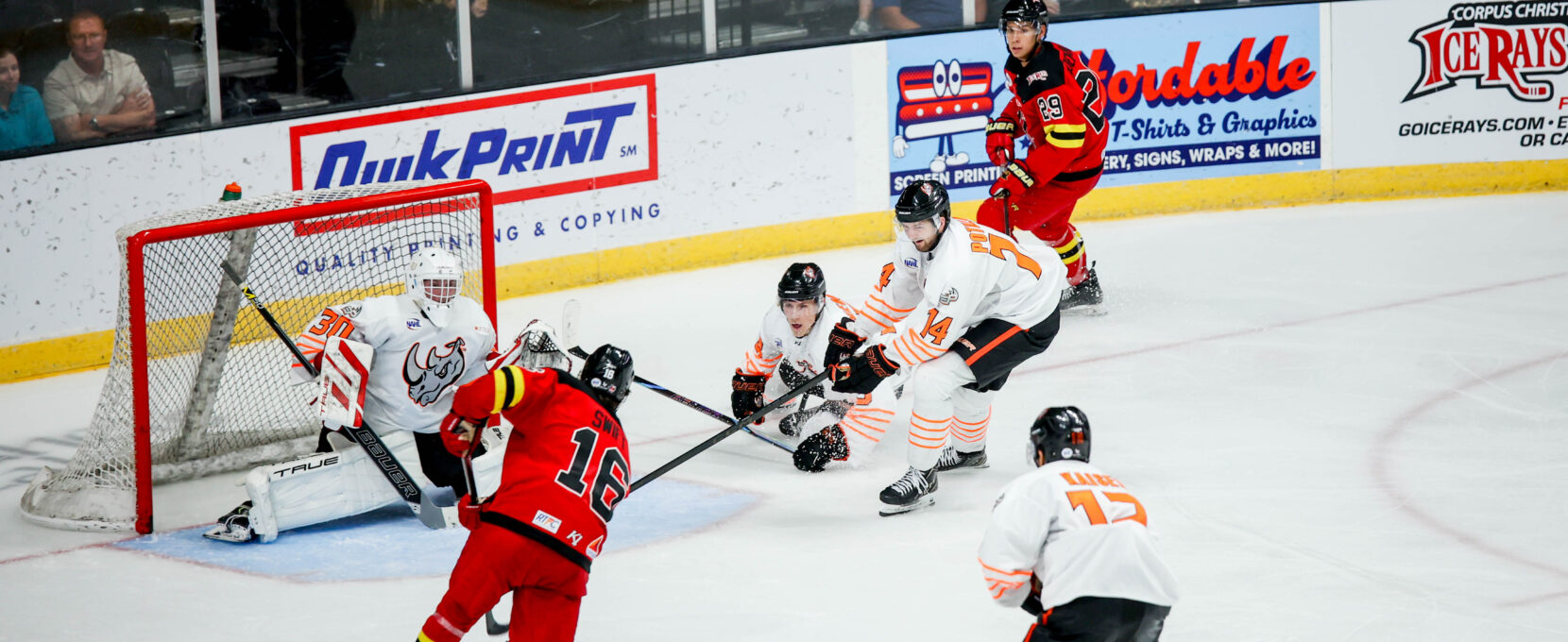
The Coastal Bend is one of the most popular migration destinations in North America, welcoming myriad species of birds and bugs from all over the continent every year. But the most foreign visitors might be a familiar yet highly specialized mammal: the junior hockey player. Traveling to South Texas from frigid, ice-hockey-crazed communities in the Northeastern United States, Canada and even European countries like Sweden and Ukraine, the players of the Corpus Christi IceRays provide locals with an up-close look at a sport that does not germinate naturally in the region.
But where do the IceRays nest?
For the past 20 years, Debbie Morris has been helping burgeoning athletic imports settle in South Texas. It started in 2006, when Morris and her late husband, Alan, offered to house Corpus Christi Hooks prospects. In 2010, when the IceRays moved from a pro team with grown men to a junior hockey team in the North American Hockey League, which requires players to be between the ages of 16 and 20, the Morrises decided to keep their doors open for visiting athletes year-round.
“We looked at each other and said, ‘Well, why not?’” Morris said. “We’ve got baseball in the summer and hockey in the winter.”

Morris’ husband passed away 10 years ago, but she has continued to house players every year, even working to expand the network of billet families in the Coastal Bend. For more than a decade, she has been the volunteer Billet Coordinator for the IceRays, a role that is part team mom and part college housing matchmaker. First, she finds families willing to take the players in and then works to find ideal pairings. The IceRays roster roughly 25 players each year; this season, the team anticipates every player will be living with a billet family.
“We inherited an unbelievable billet system,” George Manias, who took over as Chief Operating Officer and managing partner in May 2025, said. “And that’s really all Deb.”
Junior hockey sits at an interesting intersection between high school and college. Some players will complete their high school education remotely while playing, but many will be in the “gap year” age range. After the IceRays recruit players to their organization, they help their players get recruited to college hockey programs across the country.

As one of the southernmost junior hockey teams in the United States, the IceRays are in an unusual recruiting position. In most college sports, recruiting success often comes down to harvesting the talent in one’s own backyard. For the IceRays, and virtually all the teams in the South Division of the NAHL, this isn’t feasible. When your community is more used to building sandcastles than snowmen, a local hockey player is a rarer find than buried treasure.
But Corpus Christi’s stark contrast to the typical hockey environs has its perks. “Some of our kids, back home, they’re shoveling their driveways to be able to drive to practice,” Nick Skerlick, the IceRays’ head coach and director of hockey operations, said. Skerlick is entering his first season in charge of the team. He arrives having held a similar role with the Maine Nordiques for the past three seasons, and still resides in the Northeast, allowing him to scout the many tournaments, tryouts and showcases that are essential for constructing a junior hockey team.
When it comes time to sell Corpus Christi to new recruits, three things grab their attention: climate, comfort and the Hilliard Center. “The thing I hear the most is that they love being able to go to the rink every day wearing a T-shirt, shorts and a pair of flip-flops,” Morris said. “And they have access to the beach and can play golf all year ’round.” The IceRays prove that Winter Texans can be both retirees and rugrats, and everyone in between.
Being able to offer a genuine sporting arena as its home stadium is also a huge benefit for the organization. “The facility they play in, it just blows them away when they first walk in,” Morris said. Many teams in the NAHL play their official games in their practice facilities, often with limited bleacher seating, if any. The Hilliard Center, by comparison, is closer in quality and capacity to actual NHL arenas than the homes of their competitors. “It’s one of the nicest facilities in all of junior hockey,” Skerlick said.
Although the Hilliard Center is a picturesque place to call home, the IceRays do share it with other tenants, as well as touring musical acts, comedians and variety shows. Depending on scheduling, the team occasionally has to bus to San Antonio in order to get practice time on the ice. Manias said the organization is interested in constructing a practice facility in Corpus Christi that would provide the team with unfettered access to ice while also offering the chance to plant some organic hockey roots for local youth interested in playing the sport.
While the IceRays continue to focus on honing their players’ skills, Corpus Christi itself plays a role in developing them as young men, with some families entrusted to not just house them, but raise them as part of the community for as long as their IceRays career lasts. Even if a player spends only one season in the Coastal Bend, the bond they form with their host family is everlasting.
“I’ve been to college graduations, I’ve been to weddings,” Morris said. “I’ve got what I call hockey grandbabies … I’m not sure what my life would be like without these hockey kids.”
Contact
@iceraysnahl | 361.444.7825