

Last Updated on July 23, 2026 by Evelyn Martinez
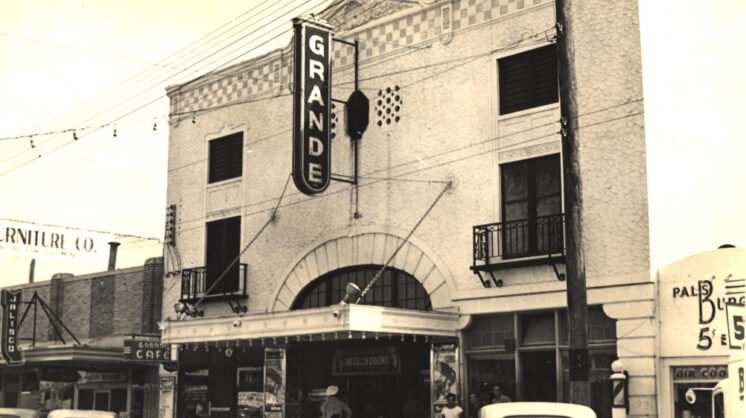
Downtown was once filled with movie theatres dispersed through its shopping districts, especially on Leopard and Chaparral. The Grande, located downtown on Leopard, opened on Nov. 25, 1928. At the time, R. and R. Gulf Amusement owned four of the six theatres in town—the Grande, the Palace, the Aldine and the Melba (right across the street from the Grande). By 1930, the city’s population of 27,741 people had enough movie theatres to seat 7,000 at a time.
Despite its name and the Spanish-influenced architecture, it was the Grande’s neighbor, the Melba, that showed primarily Spanish-language films. The Spanish architecture pictured here didn’t last—R. and R. was incredibly successful in this era and made regular updates to its theatres ranging from new carpets to complete decor changes, including entirely new facades, aimed at making return trips to the theatres fresh experiences for guests.
The facade pictured gave way to a late Art Deco style. The Streamline Moderne front, featuring a large marquee with “GRANDE” to replace the traditional theatre blade, made the exterior basically unrecognizable. The expansion of movie theatres into other areas of town led to the theatre’s closure in 1960, and the site became part of the successful Braslau Furniture Co., which moved next door in 1937. Today, the block is home to the Nueces County RTA.
Discover more of the Coastal Bend’s history here.