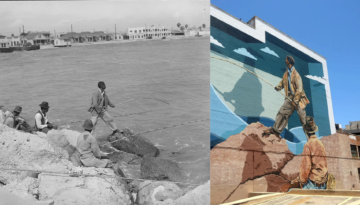

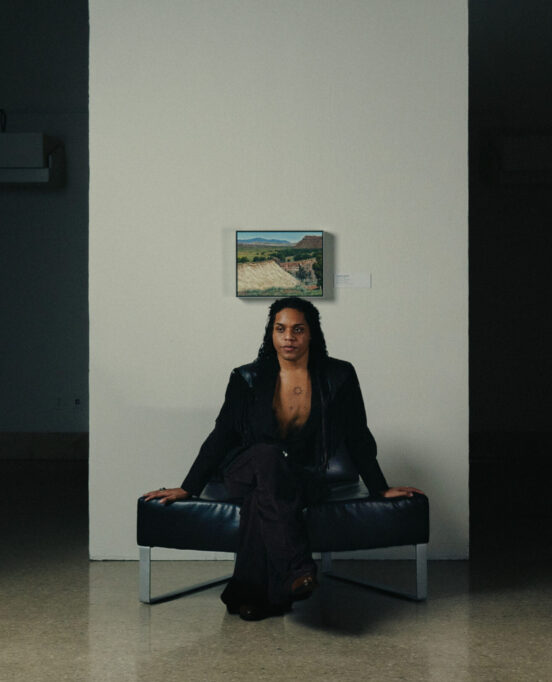
For many, home is where the heart is; for Quentin Arispe, it’s who they create with. Years after leaving their hometown, the musician continues to build nearly every major creative project with the same community of Corpus Christi collaborators—from producers to photographers and videographers—who helped shape them.
With the release of their latest album, TOMGIRL, I sat down with Arispe to discuss the record’s themes, which reflect on the love, loss and self-discovery that defined their twenties. I had the privilege of watching Arispe perform the album—a tight 28 minutes—in its entirety at an album release show in Austin after this issue went to print.
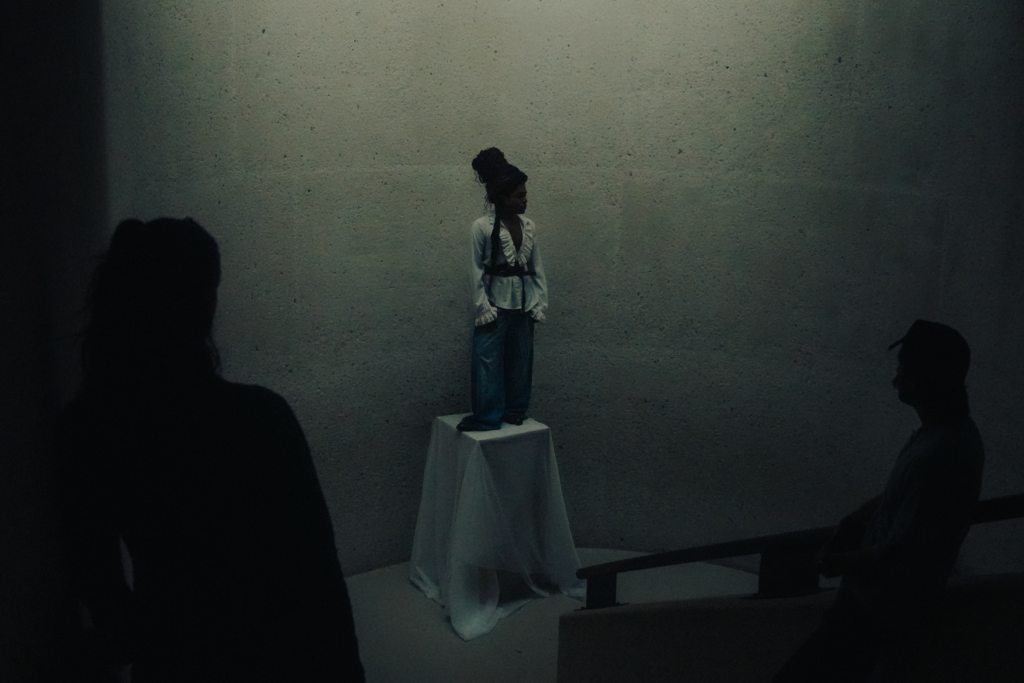
In a warehouse-like venue, a white pedestal was placed in the center of the room, with the live band’s instruments flanking each side and the crowd encircling them. The entire performance felt like both a cathartic and rewarding moment for the musician. For a performer accustomed to presenting creative works through a more persona- or character-like version of themselves, TOMGIRL has made space for Arispe to step onstage in their most vulnerable form yet.
A large majority of the crowd already knew every lyric and sang along, with favorites seeming to be “HELLO DENIAL,” “i miss new york” and the title track, “tomgirl (I’m in my head).” Arispe’s breathtaking rendition of the Carpenters’ “(They Long to Be) Close To You” was perfectly placed in the setlist and served as a true cherry on top of the evening.
When Arispe and I spoke back in June, sitting in the window booth at Lucy’s Snackbar as a thunderstorm rolled in, the conversation moved beyond the album and its inspirations to something close to heart: how staying connected to your roots, even as your career takes you elsewhere, can give flowers to the people and places who shaped you, and inspire the next generation of young, local creatives to dream a little bigger.
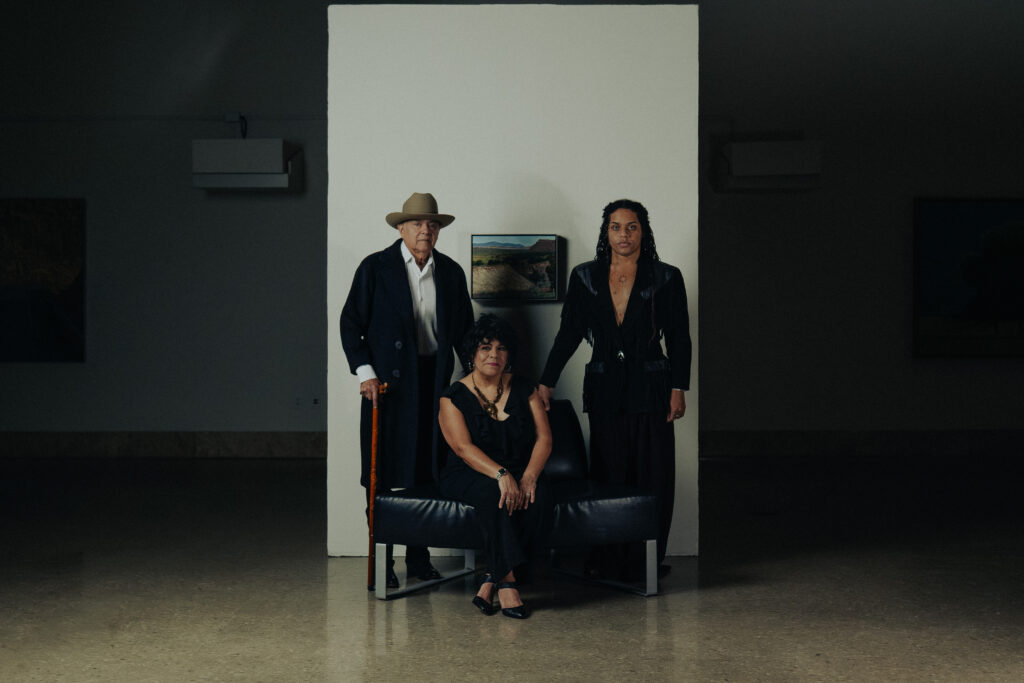
KYLIE COOPER: What’s your first conscious memory of creating—not consuming art, but realizing you wanted to contribute to it?
QUENTIN ARISPE: There are probably earlier memories I’m forgetting, but two really stand out:
One is funny because I was maybe in first or second grade. My music teacher or my classroom teacher would be trying to figure something out, and I’d raise my hand and say, “Well, what if we did it this way?” Looking back, it’s hilarious that they actually listened to me. I think I’ve always wanted to help shape things.
The bigger moment was my first theater production. It was the traveling production of The Wizard of Oz with Todrick Hall. I started as one of the Munchkins and eventually got bumped into a speaking role. The Wizard of Oz has always been one of the most important stories in my life. My whole artistic world is wrapped up in that universe.
At the final performance, they awarded a scholarship to one of the kids in the cast, and I was the one they picked. I remember standing onstage at Selena Auditorium in front of this huge audience, probably 8 or 9 years old, and realizing later that it was actually the first time I’d ever been on a stage.
My grandfather was there that night. He was probably my biggest musical influence growing up, and it ended up being the only performance of mine he ever got to see before he passed away.
I remember thinking, “Whatever this feeling is, I want more of it.” That’s when I knew I wanted to spend my life making things.
COOPER: You’ve described your new album, TOMGIRL, as a tribute to your twenties. What story are you trying to tell about who you were and who you’ve become on the other side of it?
ARISPE: I’ve had a lot of time to sit with this album now, which is really unusual for me. Normally, I’m moving from one project to the next, but I’ve lived with this record for about a year and a half. I’ve performed it, processed it and had enough distance to really understand what it is. When I think about it now, I realize it’s fundamentally a story about really intense grief. It wasn’t just relationships; it was losing [my] band, losing different versions of myself, and watching entire chapters of my life disappear all at once.
But I’m telling that story now from a place that’s much more resolved. When I was making the album and creating all the visuals around it, I was still living inside those emotions. I wasn’t looking back at them; I was actively experiencing them. Every time I perform these songs now, I look back and think, “I can’t believe you survived that. You not only survived it, but you made something from it.” Now I almost feel like the older sibling to that version of myself.
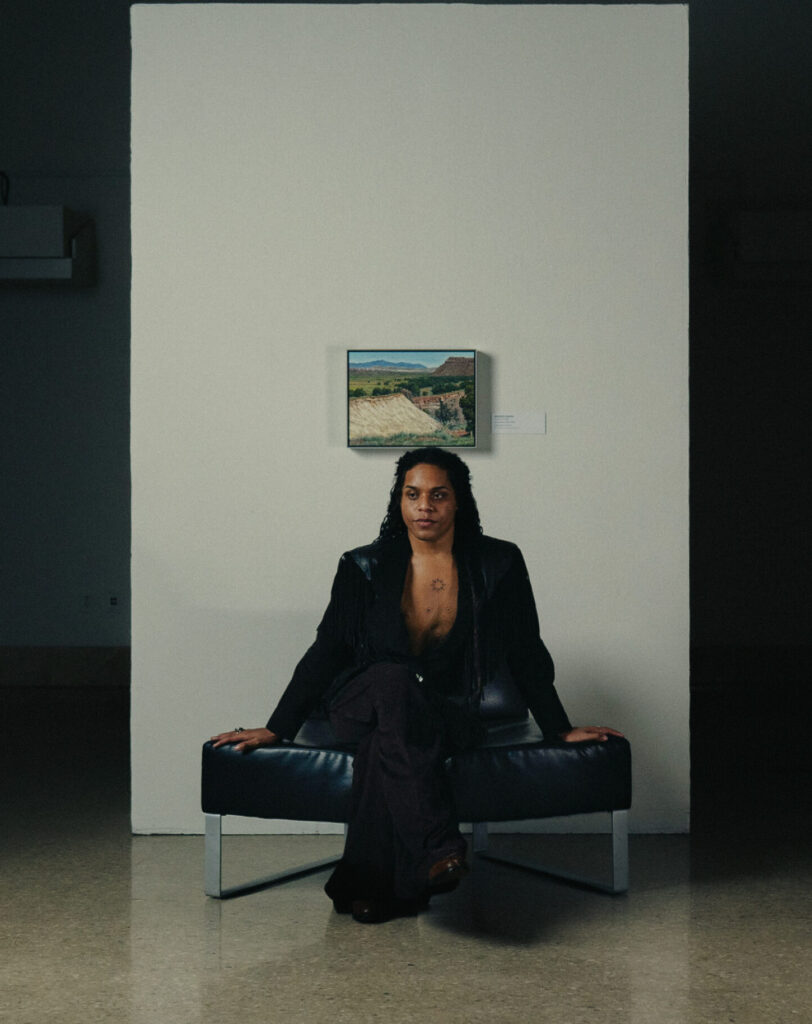
COOPER: For much of your career, you’ve explored identity through characters, personas and carefully built worlds. TOMGIRL feels different. It feels like, for the first time, you’re inviting people to meet Quentin before anyone else. What changed?
ARISPE: I think trauma forces honesty. I realized I couldn’t hide behind another character if I actually wanted to heal. Every project before this had its own identity, and those personas were never fake; they were all real parts of me. But this album needed something different.
I’ve actually never been on stage as Quentin before. That sounds strange because I’ve been performing since I was a kid, but I’ve always been performing as somebody. A version of somebody. A character. This is the first time I’ve stepped on stage as myself.
One thing that’s become really important to me is that I don’t want my identity to disappear, but I also don’t want it to become the headline. I’m a Black queer artist—that’s part of who I am, and it always will be—but I want people to experience the work first. I want the music to meet people before any assumptions do. That’s why I stripped so much away with TOMGIRL. I wanted the person to come before the persona.
COOPER: Despite now building a career in Austin, so many of the people behind your biggest creative projects are Corpus Christi creatives. Why has it been so important to keep your team filled with these same people?
ARISPE: Because they’re incredible. That’s honestly the first answer.
Sometimes people hear me talk about working with Ducky, Kinderr or El Dusty and think it’s because they’re my friends. They are my friends, but that’s not why they’re there. It’s because they’re brilliant, and we’ve grown together.
There’s a level of trust that comes from making things with the same people for years. We know each other’s instincts. We know when somebody has a better idea. Nobody’s trying to protect their ego. Our rule has always been “best idea wins.” It doesn’t matter whose idea it is.
And nobody’s above the work. Everyone is willing to pitch in. I think that’s something Corpus gave all of us. It’s a very DIY city; you don’t wait for permission. If you don’t have the resources, you figure it out, and that’s such a special way to create.
As my career has grown, I’ve never felt a reason to leave that behind. Why would I? Those are still the people I trust most creatively.
COOPER: The “best idea wins” mentality feels very akin to the Corpus Christi creative scene. There’s this willingness to pitch in, to experiment, to build something together.
ARISPE: That’s exactly what it is. Everyone’s a “yes, and …” person. Someone throws out an idea, and the next person builds on it rather than tearing it down.
That’s honestly how [my team] has always worked. I don’t ever want to ask someone to do something I wouldn’t do myself. If everybody else is carrying equipment, I’m carrying equipment. If everybody else is painting a wall, I’m painting a wall. That’s how you build trust.
When we made the visuals for TOMGIRL, there were moments where we were just figuring it out together. Somebody would have an idea, somebody else would improve it, somebody else would solve a problem we hadn’t even considered yet. That’s the magic. It’s never felt hierarchical; it’s always felt collaborative. I think that’s why the work feels like us.
COOPER: There’s a narrative people sometimes tell themselves that success means leaving your hometown, and the more successful you become, the farther away you get from it. Listening to you, I don’t think you believe that at all.
ARISPE: I really don’t. I think about Selena all the time. Not because I’m comparing myself to Selena—obviously not—but because she proved something. She showed that you don’t have to reject where you’re from in order to grow beyond it. You can carry your home with you, and that’s always been important to me.
COOPER: Sitting here now, talking about TOMGIRL, the people you’ve brought along with you and everything that’s ahead, what do you hope this version of Quentin remembers when he looks back on this chapter?
ARISPE: I hope he remembers that he trusted himself. That he told the truth and didn’t rush. That he let the work become what it needed to become instead of forcing it. I hope he remembers that he kept the people he loved close and that he kept making things with his friends. That he stayed curious.
Every chapter teaches you something new, and the goal isn’t to arrive somewhere. The goal is to keep making things that are honest enough for somebody else to see themselves in. If I can keep doing that, then I think I’ll be okay.
Follow Quentin Arispe on socials, and listen to TOMGIRL now on Spotify or Apple Music.