
Curiosity has a way of forming into a current—one that carries research into unexpected places. When Associate Research Scientist Dr. Kesley Banks thinks of a question, it often leads to another question, then a project, and so on. From tracing the movement of shortfin mako sharks to translating fieldwork into stories that invite others into the wonder of marine science, Banks—shaped by an interdisciplinary path and a belief that science is meant to be shared—approaches her work with the kind of curiosity that expands both discovery and understanding.
Shark Week, an annual, week-long Discovery Channel television event in July featuring shark-themed documentaries, is on the horizon. And, with the Center for Sportfish Science and Conservation and Harte Research Institute’s (HRI) regular appearances in the programming, Banks shares what viewers can expect from her involvement, how the Center’s Fin Finder app continues to grow and why the heightened attention paid to HRI’s shark program this time of year benefits the rest of its research as a whole.
Kylie Cooper: You’ve been involved with Shark Week programming for several years. What can viewers expect from your involvement this year?
Kesley Banks: This year is a little different: We are connecting our modern-day research to the past. I am the daughter of a marine paleontologist and grew up learning about ancient sharks (and fish), and even got a minor in geology because of it. I’m excited to help connect how ancient sharks influenced what sharks we have today. It’s been a while since I have been on a paleontological dig site, but I’m excited to bring that part of my education back to the forefront and share it with the Coastal Bend community and Shark Week audiences.
KC: Do you see increased public interest during this time translating into real conservation awareness or action?
KB: We do see an increase in awareness, but hopefully, that awareness and curiosity continue even after Shark Week is over. Shark Week provides a unique opportunity to showcase research being done in the Coastal Bend’s backyard. At the Sportfish Center, we do a variety of research, and Shark Week allows us to not only showcase our shark program, but the rest of our research, which is arguably just as interesting and cool.
KC: It’s been about a year since HRI launched the Fin Finder app. Have you seen meaningful user engagement?
KB: Fin Finder is still in its infancy, and we are continually working to improve it and make it more accessible. We have seen a ton of interest in the tracker. I think this largely stems, in this area, from a tracker that shows sharks tagged in the Coastal Bend’s backyard, and the scientists doing that work are local. It gives that research a sense of pride and ownership, seeing it done here rather than by outside researchers.
KC: What’s next for the app?
KB: We do have future expansions and updates coming. We would love to see Fin Finder as a mobile app; I think that would increase its accessibility immensely. We also hope to include other species we tag, such as billfish and cobia.
KC: What’s something about shark behavior that still surprises you, even after years of study?
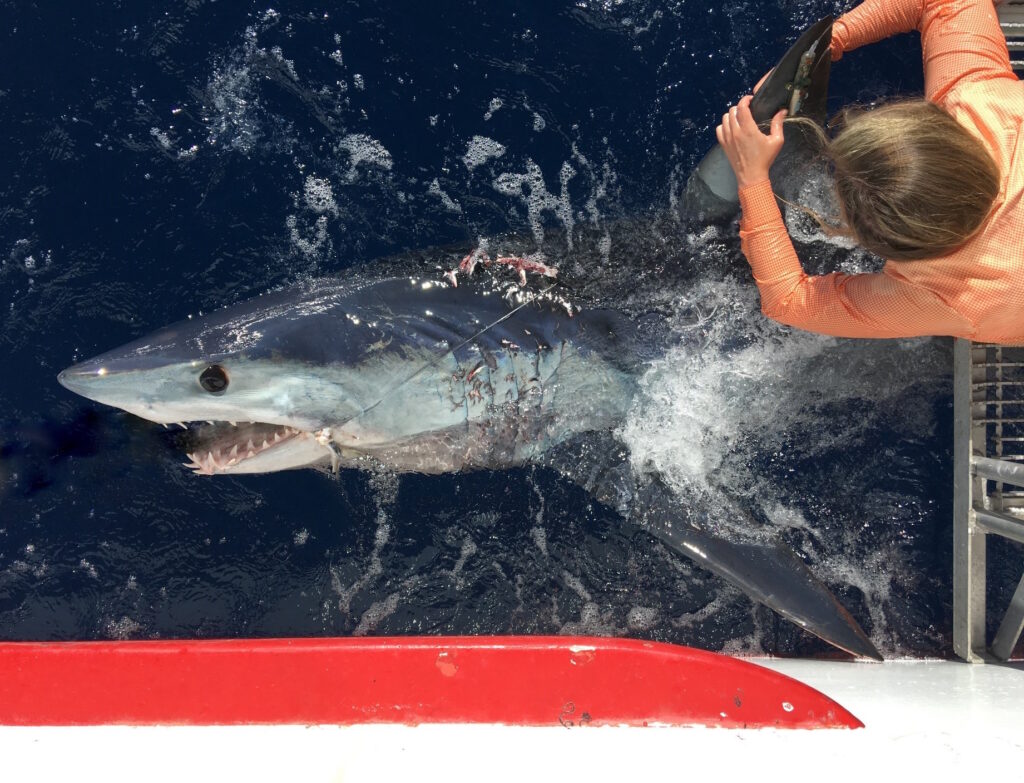
KB: Compared to many other marine species, we know so little about shark behavior. How and where many species mate and pup are still unknown. Our satellite tagging program is striving to discover this information in the Gulf—and how our Gulf populations are connected to the rest of the world.
KC: Fieldwork can be unpredictable. What’s a recent moment in the field that stuck with you?
KB: Fieldwork is definitely unpredictable, but that is what makes it fun. Working with live, untrained animals keeps you on your toes. For example, if a shark isn’t ready to be tagged, then you aren’t tagging it. People think we control the process, but in reality, the shark controls the process. A few years back, we had a really good trip. Makos are a rarer catch; you are lucky to get one or two a trip. During our multi-day trip, we got 10! It was three days of no sleep and fast-paced, and a trip that will be hard to beat.
KC: When you think about the future of marine conservation in the Gulf, what gives you hope, and what still concerns you?
KB: “Science driven solutions” is the motto and mission of the Sportfish Center and HRI. It is a humbling experience to see the research you work on influence management actions to help conserve the natural resources that support so many businesses and pastimes in the Gulf. The move to make science transparent and the inclusion of citizen scientists in the process give me great hope for the future. I think the Sportfish Center, as well as all the labs at HRI, do a great job at promoting this and giving opportunities for participation. Whatever interests you, we have a program that you can get involved in. Today, we face ever-evolving and rapidly changing environmental issues. While we are going in the right direction, we still have work to do to protect the Gulf ecosystem.
KC: If funding, policy or public awareness could shift in one major way, what would make the biggest difference on your work?
KB: Science is expensive, so funding is often the limiting factor for a lot of research. That said, getting science into the hands of managers and into regulation is the next hurdle. For us at the Sportfish Center and HRI, our goal is not to have our research sit on a dusty shelf, but to be used. So, we work at every level of the process, from doing the research to partnering with managers for the use of that research. I think funding, policy and public awareness are all important components that work hand in hand.
KC: What keeps you curious in your work and interests?
KB: My parents were very supportive of my interests and curiosity as a child and still are today. I think that has stuck with me as I move through my career. This research question feeds into the next and the next and so on. I think their support and, probably, their extreme patience with the endless questions I asked as a child ingrained that curiosity. Then, when I arrived at the Sportfish Center, my colleagues shared that curiosity. It’s easy to be curious and love what you do when everyone around you feels the same.
KC: If you could have every reader take away one thing about sharks, what would it be?
KB: A healthy ecosystem is a balanced ecosystem, and sharks are needed for the ocean to be healthy. Sharks have gotten a bad rap in the past, and I hope through our outreach and research, we are able to change that perception, maybe even inspire the next generation of marine biologists.
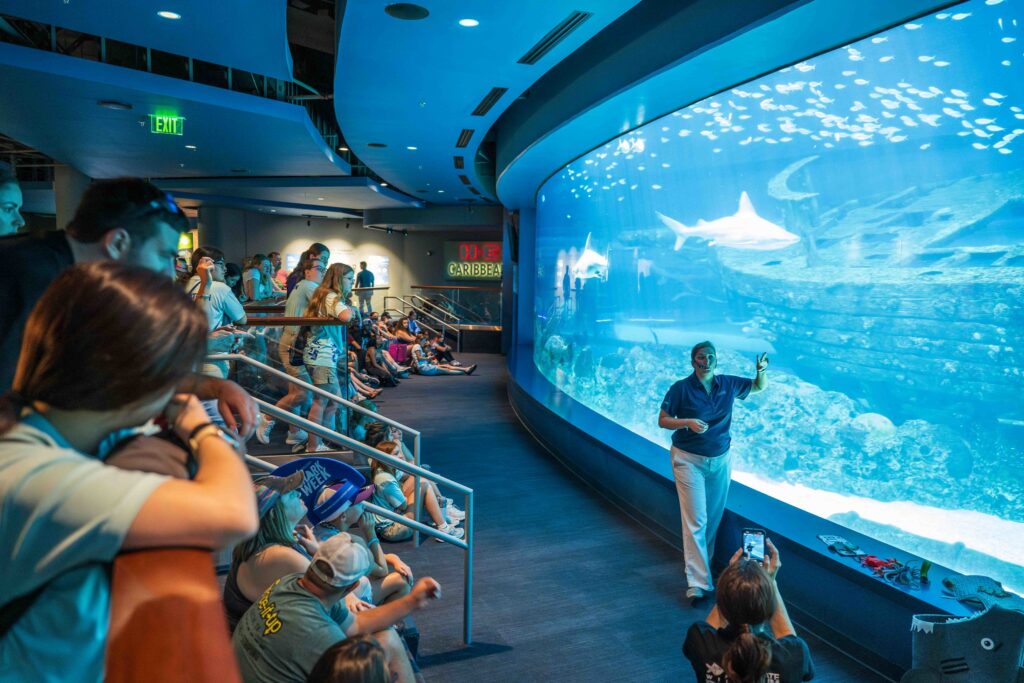
TUNE IN: Attend HRI’s Shark Week Watch Party at 6 p.m. on July 28 at Brewster Street Icehouse. HRI will host its “Let’s Talk Sharks” community event at the Texas State Aquarium at 11:30 a.m. on July 31.