

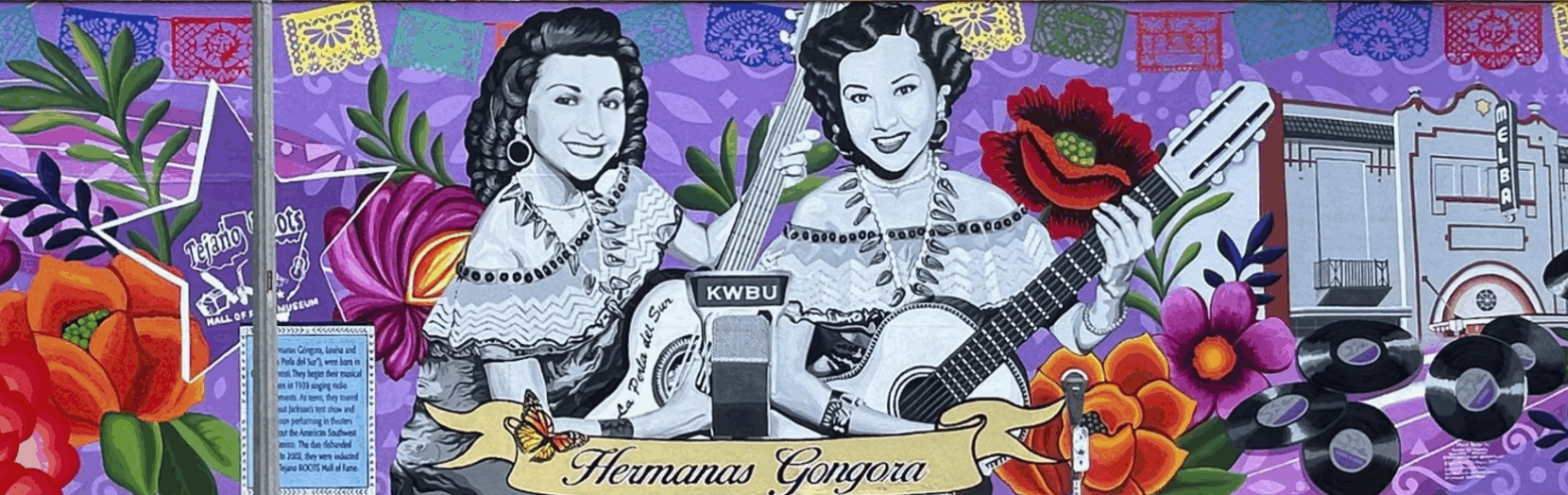
Those walking down Starr Street will find themselves face-to-face with a painted wall of striking colors. Tropical flowers and a light purple backdrop serve as adornments for the mural’s main attraction — the portrait of two sisters, guitars in hand, microphone at arm’s length, posing and smiling in traditional Mexican garments. Las Hermanas Góngora, though only the size of one building’s walls, left behind a legacy in our Tejano music history of an immeasurable scale.
“The mural is in my top three of the 28 murals K Space has done,” said Michelle Smythe, executive director of K Space Contemporary and a close friend of Lupe Góngora‘s daughter, Belinda Edwards. “They were a groundbreaking female group who rose to success in the 1940s and ’50s, a notoriously patriarchal era when few women worked outside the home. We brought renewed attention to the sisters and are, in a way, giving them a second life.”
During the golden age of Mexican regional music, sisters Louisa and Lupe Góngora gained celebrity status within the same circles as the superstars we still hear of today. Performing songs written by esteemed songwriters, alongside entertainers like Pedro Infante and Cantinflas, Las Hermanas Góngora swooned crowds from the heart of the Rio Grande Valley all the way to the Californian coast. Unlike their male contemporaries, however, the Góngora legacy remained something of an insider secret. The collaboration between K Space Contemporary and Axis Tattoo on the 2024 mural aims to bring attention to a history once lost to time.
Born and raised in Corpus Christi, the sisters came from a large family of 11. As the eldest, Lupe took care of her siblings. Music became a way for her to step out of the motherly role, learning to play guitar and sing alongside her sister, Louisa. In their early teens, the duo sang advertisements for the local KWBU radio station and went on to perform across South Texas. By 1947, they recorded their first single with Falcon Records and began touring with the Teatros Carpas. These performances, usually with Stout “Strongman” Jackson, took them out of Texas and throughout the Southwest.
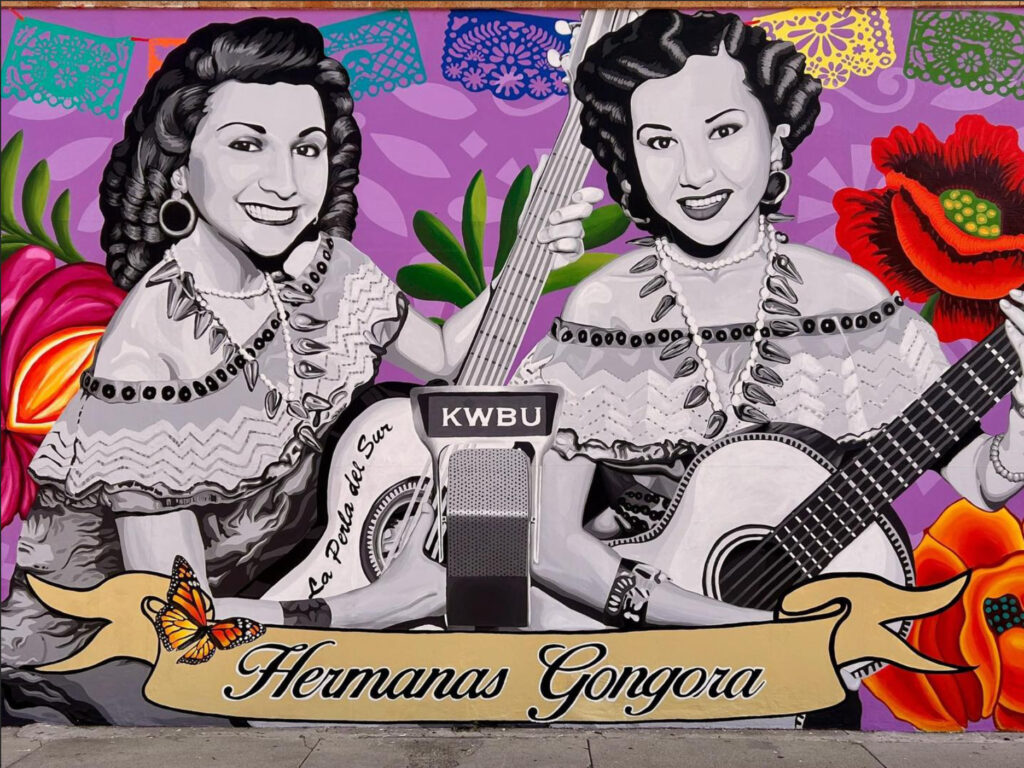
Belinda Edwards described her childhood as one of recognition and local stardom. Bar bands often brought her mother Lupe onstage, shouting, “We’ve got a celebrity in the house!” People went to their church in hopes of meeting the sisters and stopped by their family-owned restaurant, El Gallo, with memories and words of appreciation. Even Lupe’s husband, Juan Martinez, who passed away in 2007 after 50 years of marriage, fell in love with her voice on the radio before ever meeting her in person.
“She loved performing,” Edwards said. “Even at 100 years old, she’s still headstrong. She still acts like a star [when introduced to the public.]”
However, “it wasn’t always all rainbows and butterflies,” she continued. “Bad things happened with good things.” As Indigenous, Hispanic women, they faced violence and vitriol on the road and in their own communities. It felt easy to hang up the dresses, chunky earrings and guitars in exchange for a steady income and building a family. Only when she got older and joined the Holy Family church as a Eucharist minister and musician did Lupe find herself reaching for the guitar again – although, as Edwards described, a family party never ended before her father requested Lupe sing for him.
Meticulously crafted by muralists Sandra Gonzalez and Malachy McKinney, alongside the help of volunteers and high school students from K Space’s Summer Mural Arts Program, the mural intertwines Edwards’ history in the city with that of her mother’s. Painted on the side of Axis Tattoo, one of two legacy parlors owned and operated by Edwards and her husband Bruce, the sweet memories of Las Hermanas Góngora’s days of fame and their influence on the Tejano music scene will no longer be left to hide in obscurity.
Visit the Las Hermanas Góngora mural located at 701 N. Chaparral St.