

With Discovery Channel’s “Shark Week” in full swing and the recent 50th anniversary of the movie “Jaws,” the apex predator of the sea has been on everyone’s mind. But what do we really know about sharks? The Harte Research Institute (HRI) at Texas A&M Corpus Christi (TAMU-CC) has been a long-time participant in “Shark Week” activities.
Recently debuted by HRI’s Center for Sportfish Science and Conservation (CSSC), the Coastal Conservation Association (CCA) and AFTCO, is the Fin Finder app, which allows users to track sharks tagged by HRI researchers and partners. We reached out to Dr. Kesley Banks to have her weigh in on “Shark Week” and the HRI’s effect on shark research and conservation.
As a five-time participant in “Shark Week” programming herself, Dr. Banks provides an insider view into the effects of Shark Week and the HRI on shark conservation. After reading, you can find Dr. Banks this Friday at 11:30 a.m. at the Texas State Aquarium, where she will give a “Shark Talk” in front of the famous H-E-B Caribbean Sea Exhibit.

Darcy Stineman: How has working with the HRI changed your perspective or strengthened your convictions regarding research about sharks?
Dr. Kesley Banks: I have always wanted to work with sharks, even as a little girl growing up in the land-locked state of Tennessee. So, this is a dream come true for me. Working with anglers for shark conservation has been one of the greatest influences for me. These people have a passion for the fishery and these apex predators that is contagious and inspiring.
DS: From a popular culture perspective, what is your opinion on how sharks are portrayed in the media? How do you hope that portrayal or cultural opinion will change?
KB: Sharks get a bad rap when it comes to television and news. They are often portrayed negatively and as ‘out to get us’ when that just isn’t true. I hope to show people that the real scary organism in the ocean is us, and that an ocean without sharks is less productive than an ocean with sharks. I believe this is achievable through the next generation, and I hope to inspire the future generation of marine biologists to take up this charge.
DS: What has the HRI done for shark research in your experience?
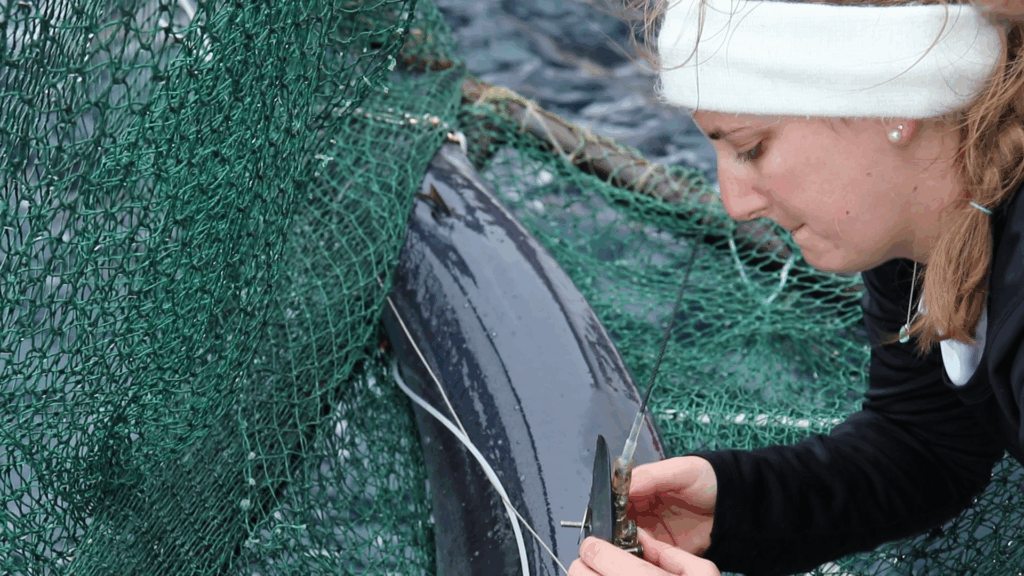
KB: Shark science is still in its infancy. For many species, we do not even know where they go, where they mate, where they pup, etc. We here at the CSSC are trying to help answer some of those questions. For example, shortfin makos, the fastest shark in the ocean, were thought to leave the Gulf each summer and return in the winter when water temperatures cooled down. Our tagging work suggests that some do leave, but females and younger males may in fact stay all year long. We also have a very large citizen science tagging component that allows us to work with recreational shark anglers to monitor species composition in the land-based shark fishery. These anglers take biological data on the sharks they catch, tag them, and then release them.
DS: How did the Fin Finder tool come about, and what role do programs like it play in conservation?
KB: Fin Finder is a collaborative effort between us here at the CSSC, AFTCO and CCA to bring awareness to sharks. These three leaders in conservation have teamed up to create a tool that not only helps scientists study these ocean apex predators but also allows the public to follow their journeys and better understand their critical role in the broader marine ecosystem.
With CSSC scientists tagging sharks and contributing research expertise, AFTCO providing a conservation-driven platform and CCA championing sustainable fisheries, the collaboration is uniquely positioned to advance shark conservation. With Fin Finder, we’re not only able to collect valuable data on shark movements and behavior, but we’re also inviting the public to follow along and see why these apex predators are so vital to ocean health. Our team has tagged a diverse range of sharks in the Gulf, and this tool helps bring their incredible journeys to life while supporting long-term conservation efforts. As the challenges facing sharks continue to grow, partnerships like this — grounded in science and fueled by public engagement — are essential to securing a sustainable future for these remarkable predators and the oceans they call home.
DS: How has “Shark Week” programming and your participation in it influenced your perception of sharks?
KB: Like I mentioned before, I always wanted to study sharks, so appearing on “Shark Week” was on the bucket list. I will say the pressure of getting the sharks to cooperate in the narrow window you have to film each episode is a nail-biter. We often get what we need in the last few days or hours of filming. I love that it allows for shark research to be shared with the general public and that the passion of the researchers on television is so apparent.
DS: How has the HRI’s participation in “Shark Week” programming influenced “Shark Week” in particular?
KB: I believe it sparks interest in our community. I mean, who doesn’t want to see research being done in their backyard featured on television, especially a week-long program like this? Hopefully, the community is proud to see that, and excited that this research is on-going near them.
DS: Can you give a little sneak peek at the kind of information you will cover in your “Shark Talk” presentation at the aquarium?
KB: We will be talking about how “Jaws” influenced shark science, and it might not be what you think. Despite the negative persona sharks received after the book/movie came out, shark science got a boost. We will be discussing fun facts from the movie and translating that to research that has been conducted on sharks.