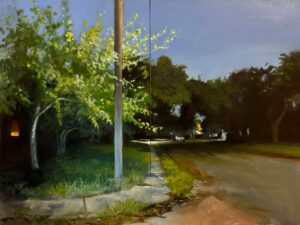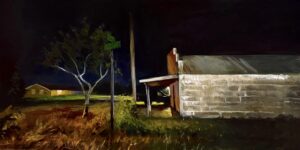

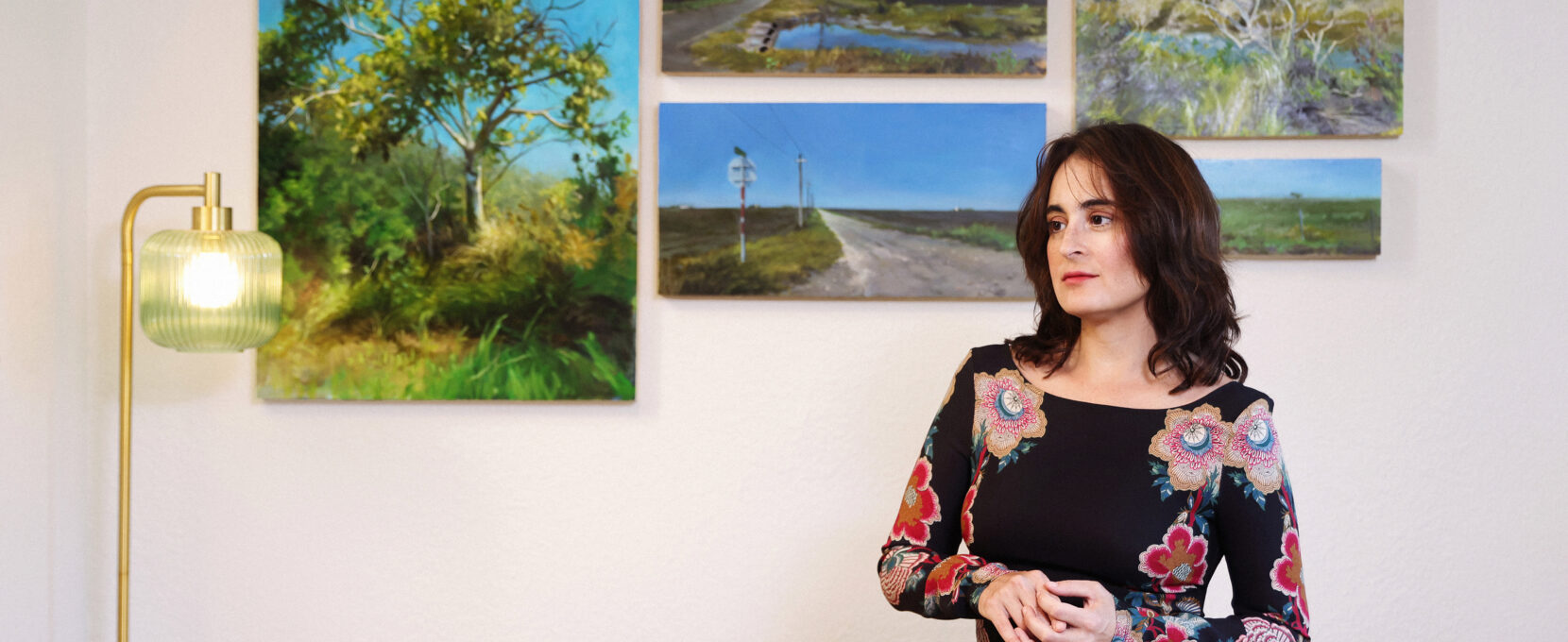
In the soft edges of her paintings, Elena Rodriguez navigates the feelings of awe, fear and beauty that British Romantics once called “the Sublime.” Walking a path illuminated mainly by the safety light worn on her chest—meant to steer off the dangers of oncoming traffic—she takes in the numinous images cast in darkness, grounded only by two large dogs and a keen sense of the natural precariousness that lurks in the night. Still, in the background of her panels are signs of life: a street lamp, a stop sign, a Toyota Corolla. The blended phenomena of primal fear and exceedingly human comfort are where Rodriguez chooses to linger.
“The dark is all-encompassing, and some primal part of us remembers that nighttime is when there is danger and predators,” Rodriguez said. “This ‘scary’ nighttime is when all the artificial trappings of humanity bring some comfort, whether that’s a car’s headlights or a street lamp.”
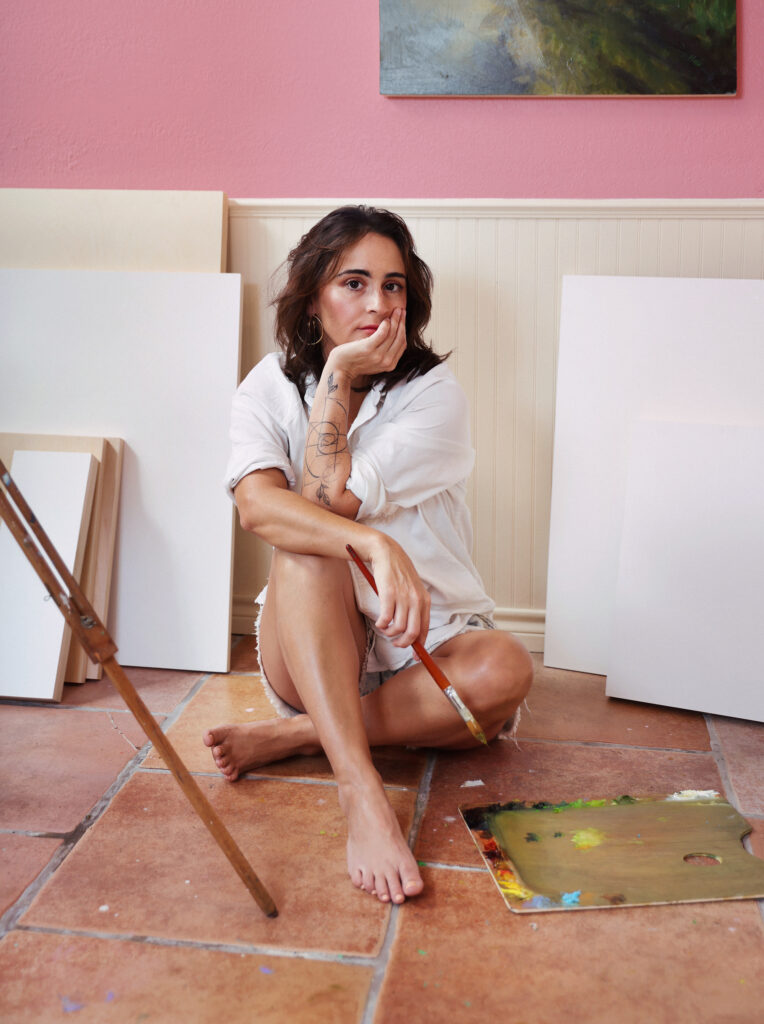
Rodriguez has called many corners of the art world home. A Dallas-area native, she explored the Dallas Arts District in adolescence and took an early interest in painting before going off to earn a bachelor’s degree in fine art at Washington University and finally a master’s in fine art from the New York Academy of Art. After learning her craft and studying traditions based in French Classicism, she traversed the realities of being a working artist in New York City. Paying rent, juggling a job to pay said rent and keeping a secondary studio in South Williamsburg and then Bushwick—Rodriguez recalled all with fondness but no envy given her current slot in life.
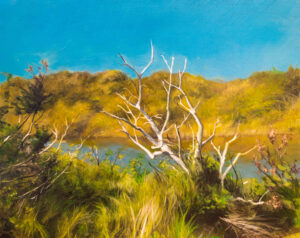
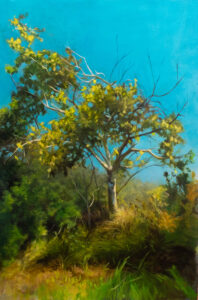
“I was still trying to figure out my voice,” Rodriguez said of her early career in New York. But longing for her home state and a change of pace, she embarked on the long haul from the East Coast to the Coastal Bend, settling first in Rockport and then Corpus Christi. The novelty of a new place soon became routine, and from routine burgeoned inspiration. In the flat landscape of South Texas, she found beauty in endless horizons, wide blue skies and a dense creeping fog found only on the humid shores of the Gulf Coast.
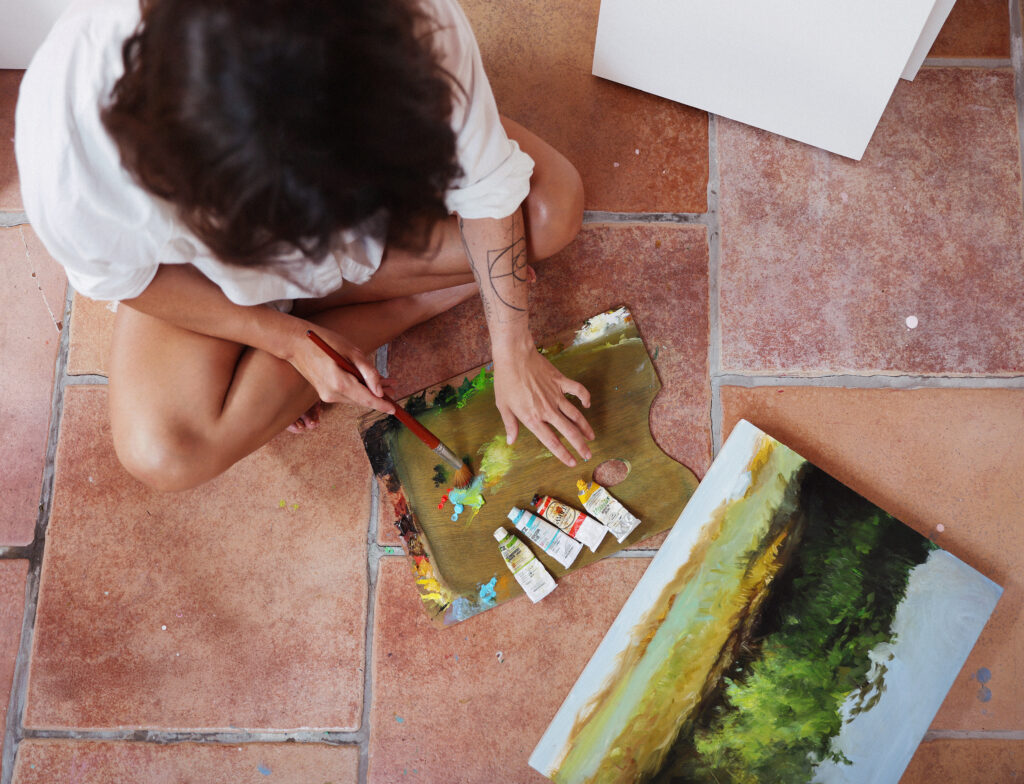
An oil painter with a preference for crafting images on wood panels, a method used by most painters prior to the Dutch popularization of canvas in the 16th century, Rodriguez captures the tactile feel of her environment while casting it from a snippet in time. Her nightscapes, in particular, marry the comforting and liminal qualities of a neighborhood cast in total darkness, illuminated by a limited light source.
“A lot of the work is me taking the photo while walking my dogs,” Rodriguez said, explaining the method behind some of her night scenes. “I have a giant light that I wear so I don’t get hit by cars. And I seek to put it in there because I think it suggests a human presence you cannot see. There’s a light source that’s being cast off-frame onto this scene.”
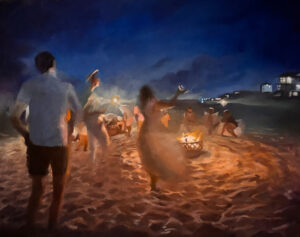
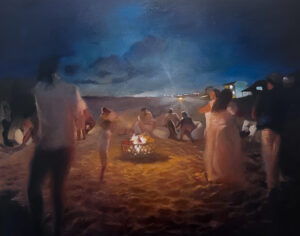
In her campfire series, including “Cherished Destiny” and “What are you doing Sundays,” Rodriguez returns to figures in a communal scene. Adept at departures from tradition, the artist plays with distortion in the foreground as it appears in her references, whilst choosing to paint the figure simultaneously in imperfectly captured motion. Concentric patterns of humans gathered around a flame speak to the sense of community in these pieces, while her nightscapes convey a sense of empathy in seeing the world like memories or dreams conjured into the mind of another.
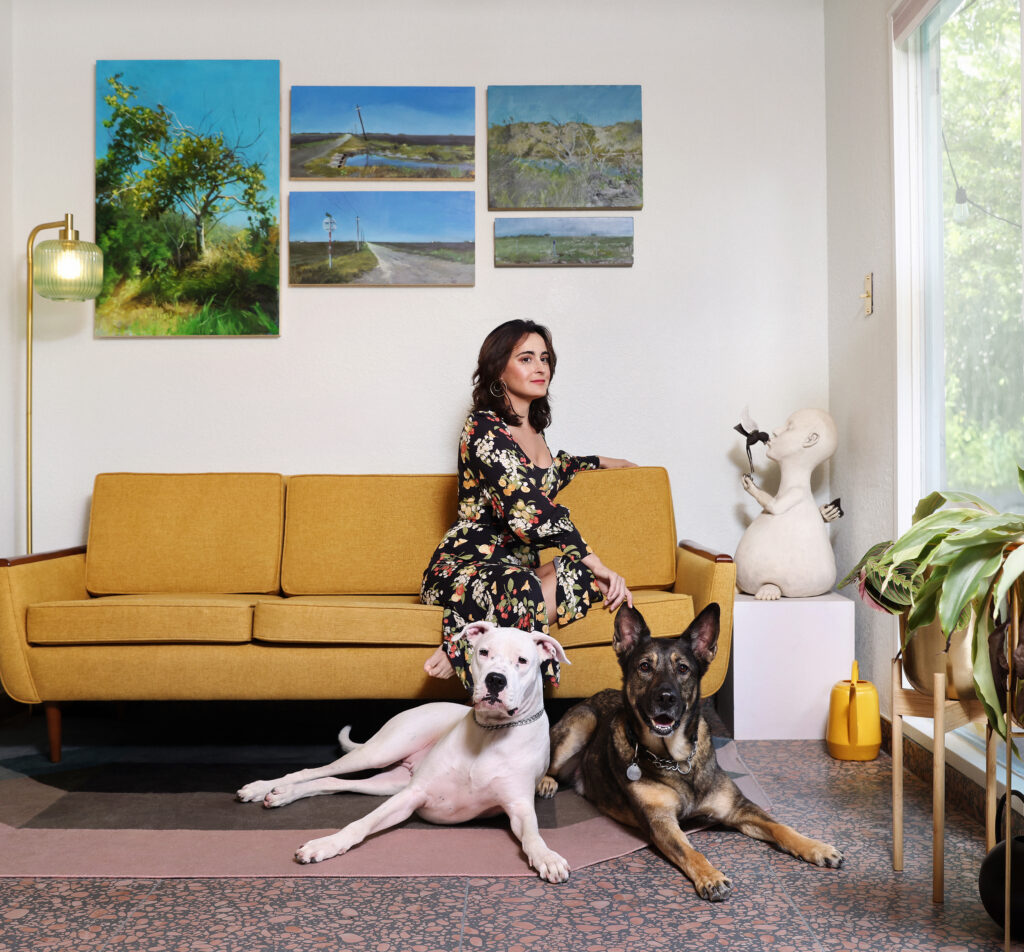
Seeking community while present in her work has also played an integral role in Rodriguez’s career as an artist since moving to the Coastal Bend. She sold her first painting upon moving to South Texas in 2013 and worked out of a studio at K Space starting in 2020, where she recalls beginning to feel empowered by the accessibility of the space to paint what she wanted. Rodriguez credited the artistic community here as cultivating a sense of support and non-competition.
“Corpus and the Coastal Bend area are very friendly; people tend to help each other out,” she said. “And I think that’s true statewide, but also specifically here. People buy because they like the art and support the work, which is really important.”
Empowering herself to take steps forward in her career also informs her practice as an art educator at Del Mar College, where she hopes to encourage artists in the beginnings of their craft and career.
“The hardest thing for students to overcome is that they’re scared to fail, but it’s just art. You should take risks,” Rodriguez said. Imparting advice for future artists, she was simplistic. “Be happy. There’s a lot of non-success. You gotta find a way to be happy.”