
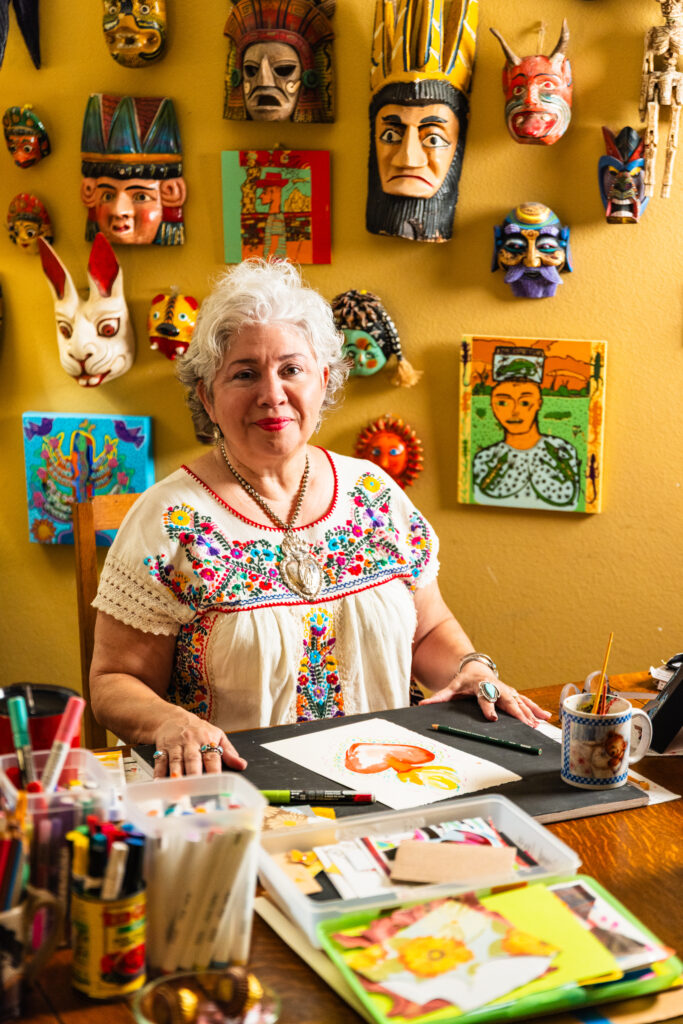
Every night, when she settles into the quiet corner of her studio, Mexican folk artist Nora Verdin works under watchful eyes. More than a dozen handmade Mexican masks hang behind her, overlooking her process in a range of emotions—smiling, frowning, worried, proud. Some stick out their tongues; others resemble folk legends more than people. Each tells a wordless story, echoing ancient traditions through color, texture and form. Folk art, often an elusive genre to define, connects the faces on her wall to the alebrijes on her shelf and to the piece currently taking shape beneath her hands, sharing a common thread: generations of artists whose inherited traditions make even a single stand-alone gallery piece possible.
“These traditions are passed down from generation to generation,” Verdin said. “Their mom did it, their grandmother did it, their grandfather did it, and they, in turn, have learned to do it. That is exactly why [the genre] appeals to me. These artists are not necessarily formally trained, but their art can still be beautiful. They are celebrating cultural traditions, but they’re also celebrating family traditions as well.”
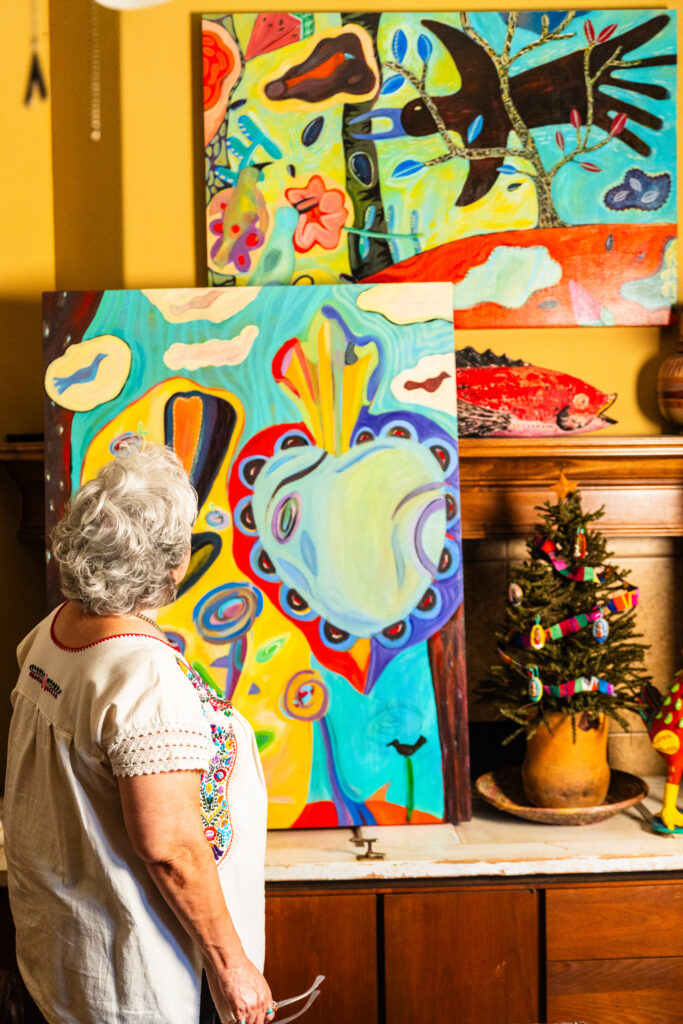
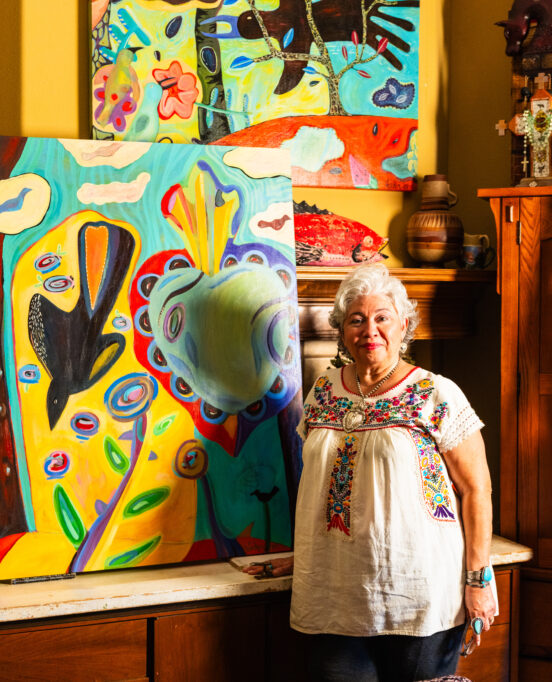
Well-versed in global interpretations of folk art, Verdin blends historically rooted colors, motifs and iconography with her own cultural lens, offering a modern take on the Mexican folk art style. Forty-some years into her practice, Verdin has shifted places in the Coastal Bend community from mentee to mentor, passing her talent on to new inheritors—her gifted children; the thousands who have studied her work in galleries; and the students who have learned to love and create art through her teaching.
Working primarily on wood panels, her paintings commonly depict birds and flowers in honor of her mother, as well as Catholic imagery like the Virgin de Guadalupe and the Sacred Heart. She packs hundreds of meticulous details into intimate spaces, layering vibrant colors and patterns often absent from her earlier large-scale works. The smaller format, paired with her intuitive mixing of collaged paper, gel pens and acrylic paint, brought her back to creating by instinct rather than instruction.
The shift felt inevitable. She grew up watching her father carve wooden birdhouses and her mother sew late into the night. Following that intrinsic tradition made her not only a folk artist by trade but, seemingly, also by genetic makeup.
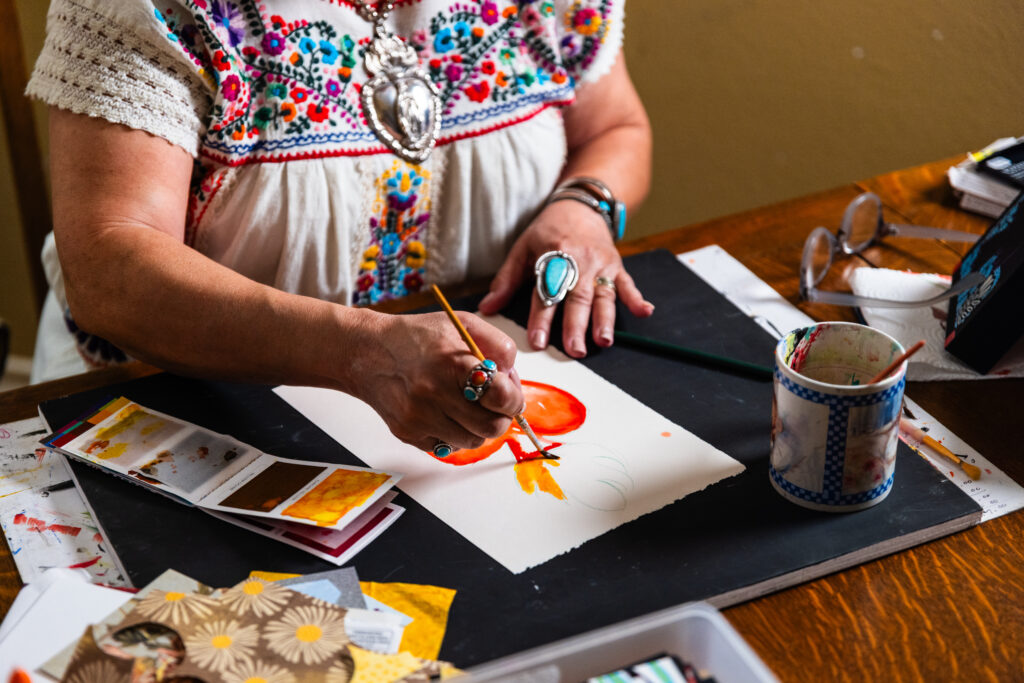
“It makes sense [if] there’s an artistic family gene that a few of us inherited,” reckoned Nola Guajardo, Verdin’s twin sister, whose artistic career closely intertwines with hers. “We grew up hearing stories about [our] great, great, great grandfathers who painted murals and churches in Mexico. We have a first cousin, too, Joe Peña, who is a professor of art at TAMU-CC and a fabulous artist. The artistic part of [our history] was told to us when we were young, so that made it interesting for [Nora] to choose [a career in the arts].”
Raised in a tight-knit family, Verdin’s childhood looked like Sunday morning mass, summer road trips and bickering with her siblings. Known as the “art twins” in the Coastal Bend scene, she and her sister grew up inseparable.
Although an eventual abstractionist, Guajardo pursued a degree in psychology, while Verdin continued on her path toward becoming a trained artist and art teacher. The twins’ future seemed to diverge. With only 12 credit hours left until graduation, a required painting class—and what she described as “the voice of some sort of angel” visiting her dreams—set Guajardo onto the same path as her sister’s. “And I’ve never regretted it,” she declared.
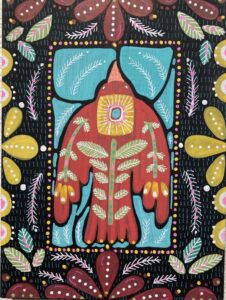
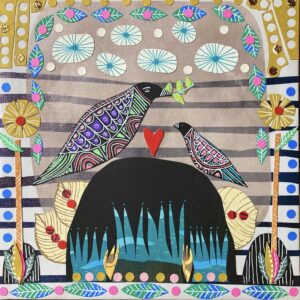
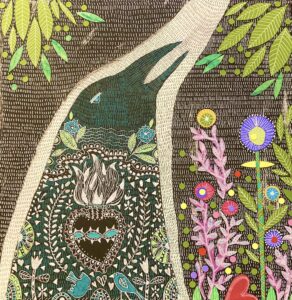
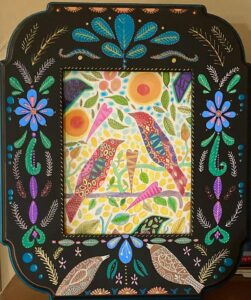
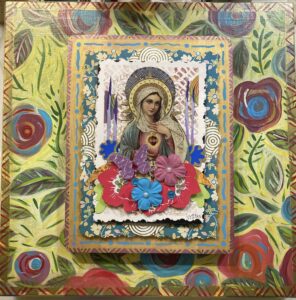
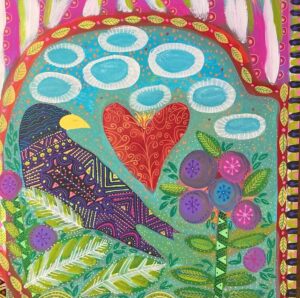
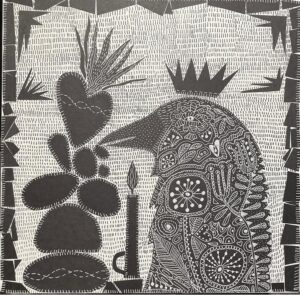
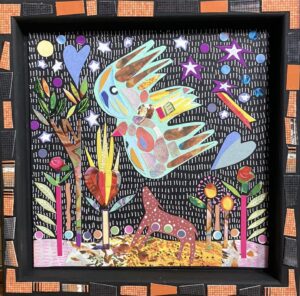
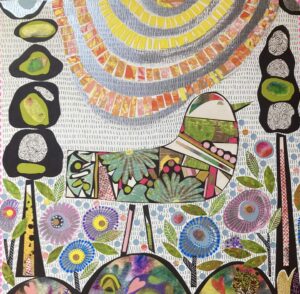
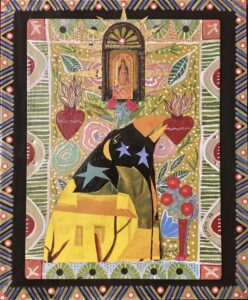
After earning their master’s degrees and teaching certificates, the twins embarked on the next chapter of their lives. The Coastal Bend called them home, so home they went, moving in together after spending grad school apart. For the next three decades, they taught art in CCISD schools while never sacrificing their own craft, remaining each other’s biggest cheerleaders, collaborators and closest friends. Their work hangs in galleries and permanent collections across the city, even making their way into Cheech Marin’s Chicano Art collection.
With both only a few years into retirement, the “art twins” continue to ceaselessly create and pass on their talents to emerging stars.
“I teach at [TAMU-CC] in the fall, my sister teaches in the spring,” explained Verdin, both working with up-and-coming artists and eventual art teachers. “I love being in that energy [and] being an influence for [my students], being a little friend for them. That’s a whole generation, sometimes two generations, from me. It continues to circle back around—I was that student one time, and now I’m the elder.”
A night owl at heart, Verdin’s newly freed time allows her to maintain a daily routine. She slips into her at-home studio around 9 p.m., and there she remains, long after the house has gone quiet and the clock slips past midnight. She’ll play her working music, a mix of classic rock, folk and the occasional Billie Eilish track. In the warm, glowing circle of her studio light, she’ll continue to paint, quietly shaping another link in a long lineage of artists.